
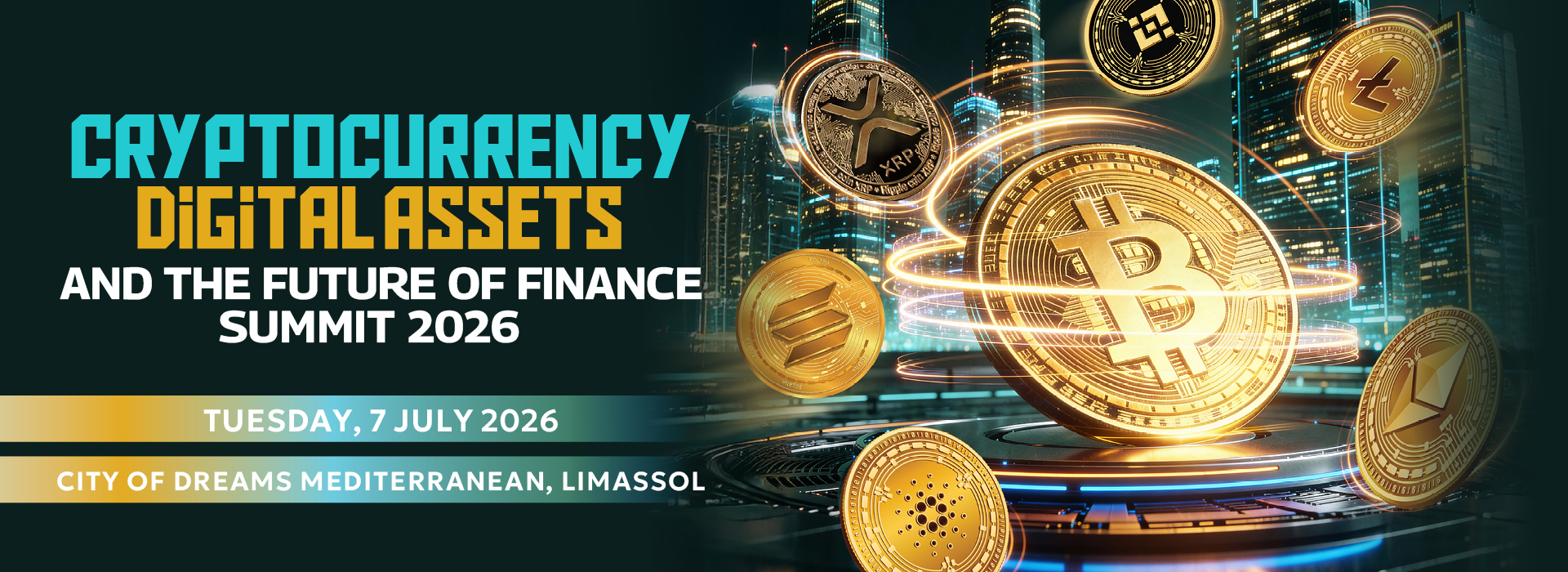
Cryptocurrency, Digital Assets and the Future of Finance Summit 2026
The global financial system is entering a historic transformation. Cryptocurrencies, stablecoins, CBDCs, tokenized real-world assets, and blockchain-powered financial infrastructure are no longer peripheral experiments — they are rapidly becoming the backbone of the future economy. Payments are evolving into programmable transactions, markets are shifting toward tokenized settlements, and digital identity and ownership frameworks are creating new economic models for businesses and individuals.
The Cryptocurrency, Digital Assets and the Future of Finance Summit 2026 is a leading forum for institutional leaders, innovators and investors exploring the convergence of crypto, blockchain, and mainstream finance. The summit is addressed to senior leaders from investment firms, crypto companies, traditional financial institutions, regulators and policymakers, blockchain providers and developers, fintechs, private equity, hedge funds, and venture capital firms. The Cryptocurrency, Digital Assets and the Future of Finance Summit 2026 will bring together the world’s most influential regulators, visionary technologists, institutional investors, financial institutions, policymakers, and digital asset innovators to define the foundations of Finance 3.0.
As the digital assets landscape is evolving faster than ever before, and as Cyprus is becoming an important European Financial Services Centre, the summit will tackle the next wave of transformation: from the Crypto revolution to tokenization of real-world assets and digital asset allocation strategies to the evolving regulatory landscape and blockchain infrastructure.
This summit serves as a platform for clarity, collaboration, and high-level insight at a time when global frameworks such as MiCA, DORA, the Digital Euro, and emerging CBDC ecosystems are reshaping the rules of global finance.
Why the Summit Takes Place in Cyprus
Though the summit carries a global identity, the host location — Cyprus — plays a strategic and powerful role in the world of digital finance.
Cyprus is:
- A rapidly emerging EU hub for crypto, fintech, investment firms, blockchain service providers, and CASPs. (Crypto Asset Servive Provider)
- A jurisdiction with a high density of regulated financial entities, including investment firms, EMIs, payment institutions, and MiCA-ready CASPs.
- A preferred base for major global exchanges and digital asset institutions, which seek EU alignment and access to European markets.
- A country where regulators such as CySEC and the Central Bank of Cyprus actively collaborate with industry stakeholders to create a modernized regulatory environment.
- A natural bridge between Europe, the Middle East, Israel, and Africa, facilitating investment, technology partnerships, and cross-border digital finance initiatives.
Cyprus combines the stability of an EU jurisdiction with the dynamism of a global financial gateway. Hosting the summit here allows global leaders to see firsthand how Cyprus is becoming a strategic launching point for digital asset innovation across continents.
Why Attend
Expand your network, exchange ideas, and build partnerships that drive success by meeting with the top leaders in the industry from:
- Investment Firms
- Traditional Financial Institutions
- Crypto Asset Service Providers (CASPs) and Crypto-Assets-Entities (MiCAR)
- Blockchain providers and developers
- FINTEC companies
- Institutional Investors, Private Equity, Hedge Funds, Venture Capital Firms
Key Topics
SESSION 1: THE REGULATORS’ AND POLICY MAKERS AGENDA
Digital assets have become a central focus of financial policy and regulation worldwide. As crypto-assets, stablecoins, tokenized markets and digital forms of money gain scale, public authorities and supervisors are shaping frameworks that support innovation while safeguarding financial stability, market integrity and consumer protection. This opening plenary examines the key policy, regulatory and supervisory priorities defining the next phase of digital finance, including the oversight of digital asset markets, the role of central banks, and the need for effective cross-border coordination in an increasingly interconnected global financial system.
- Policy and regulatory priorities shaping digital asset markets
- Supervisory approaches to crypto-assets, stablecoins and digital asset service providers
- Financial stability, market integrity and consumer protection considerations
- The role of central banks and public authorities in the era of digital money
- Cross-border regulatory coordination and international policy alignment
- Key challenges and emerging risks in the evolving digital finance ecosystem
SESSION 2: DIGITAL ASSETS: THE STATE OF THE MARKET
CRYPTO, DIGITAL CURRENCIES & THE FUTURE OF MONEY
Digital assets are now firmly embedded in global financial markets, with increasing participation from regulated institutions, licensed service providers and international market infrastructures. This session provides a current, market-oriented assessment of developments across crypto-assets, digital currencies and blockchain-based financial services, viewed through the lens of institutional adoption and regulatory alignment.
The discussion brings together perspectives from banks and investment firms operating under MiCA, Crypto-Asset Service Providers (CASPs), and regulated crypto exchanges, reflecting developments across multiple European jurisdictions and global markets. Attention is given to market structure, liquidity conditions, governance models and the evolving role of regulated intermediaries in digital asset ecosystems.
The session also explores how blockchain and artificial intelligence are transforming financial markets, the interaction between centralised and decentralised finance, and the expanding range of investable digital asset classes, including cryptocurrencies, NFTs, asset-backed tokens and tokenised real-world assets. Developments in digital payments, sustainability considerations and long-term market resilience form part of the broader discussion.
Key topics include:
- The current state of digital asset markets and key industry trends
- Institutional participation by banks, investment firms and regulated CASPs
- The role of regulated crypto exchanges and market infrastructure
- Centralised and decentralised finance: use cases, convergence and risk
- AI and blockchain applications in trading, payments and market operations
- Emerging digital asset investment models, including tokenised real-world assets
- Digital payments, settlement and cross-border transaction developments
- Sustainability and long-term considerations for digital asset markets
SESSION 3: ASSET ALLOCATION STRATEGIES: HOW DO DIGITAL ASSETS FIT IN AN INSTITUTIONAL PORTFOLIO?
Digital assets are increasingly being considered within institutional portfolios as markets mature, infrastructure develops and regulatory clarity improves. A growing number of asset managers and institutional investors are now evaluating crypto-assets, tokenized instruments and blockchain-based investment models alongside traditional asset classes.
How do institutional investors approach digital asset allocation, including portfolio construction, risk and return assessment, governance and execution considerations? What is the role of tokenization in expanding investable opportunities and improving access to liquidity in traditionally illiquid assets?
Perspectives from asset managers and investment firms with dedicated digital finance and crypto capabilities.
Key topics include:
- Institutional sentiment toward digital assets and allocation trends
- Digital Assets Trading Strategies
- Institutional investing & digital asset allocation
- Integrating Digital Assets into Institutional Portfolios
- Portfolio construction and the role of crypto-assets as a diversifier
- The investment/ors point of view
- Risk management, asset classification and valuation methodologies
- Barriers to adoption and key concerns for institutional investors
- Institutional-grade infrastructure, custody and market access solutions
- Tokenization as a tool for accessing illiquid assets and improving efficiency
SESSION 4: THE FUTURE OF CRYPTOCURRENCIES
Cryptocurrencies are entering a new phase of development as regulatory frameworks, market infrastructure and institutional participation continue to mature. This session examines the future role of crypto-assets within regulated financial markets, focusing on market structure, adoption pathways, governance standards and long-term sustainability.
The session reflects the experience of MiCA-licensed banks and investment firms, Crypto-Asset Service Providers (CASPs), asset managers and regulated crypto exchanges, across multiple European jurisdictions and international markets. Emphasis is placed on how regulatory clarity, institutional-grade infrastructure and evolving risk management practices are shaping the role of cryptocurrencies in investment portfolios and financial services.
Key themes include the interaction between crypto-native and traditional financial markets, the evolution of liquidity and trading models, and the positioning of cryptocurrencies within broader digital asset ecosystems.
Key topics include:
- The evolving role of cryptocurrencies in global financial markets
- Regulatory and supervisory developments under MiCA
- Institutional adoption and market maturity
- Liquidity, trading infrastructure and custody models
- Risk management, governance and market integrity
- Cryptocurrencies within diversified investment strategies
- Long-term outlook and sustainability of crypto-asset markets
SESSION 5: THE FUTURE OF STABLECOINS: STABLECOINS & THE EVOLUTION OF DIGITAL PAYMENTS
Stablecoins are increasingly positioned at the intersection of digital assets, payments and financial infrastructure. As market adoption grows and regulatory frameworks take shape, stablecoins are evolving from crypto-native instruments into regulated financial products with expanding use cases across payments, foreign exchange, settlement and cross-border transfers.
This session explores how regulated stablecoin models are being designed, governed and integrated into existing banking and payment systems, as well as the implications for efficiency, cost, transparency and financial stability. It also considers the interaction between stablecoins, traditional payment rails and emerging forms of digital money, including central bank digital currencies, from both a policy and market perspective.
Key topics include:
- The role of stablecoins in payments, FX and cross-border transactions
- Regulated stablecoin models and supervisory expectations
- Reserve management, transparency and governance
- Integration of stablecoins with banking and payment infrastructure
- Stablecoins and financial stability considerations
- Interaction between stablecoins, CBDCs and traditional payment systems
- Opportunities and challenges for institutional adoption
SESSION 6: TOKENIZED ASSETS & TOKENIZATION
Tokenization is emerging as a key innovation in financial markets, enabling securities, funds and real-world assets to be represented and transacted on distributed ledger infrastructure. This session examines how tokenized instruments are transforming issuance, settlement, custody and secondary market activity, while enhancing efficiency, transparency and access to liquidity.
The focus includes tokenized securities and investment funds, as well as the tokenization of real-world assets, and how these developments are unlocking new opportunities within traditional markets. Attention is also given to the regulatory, operational and market considerations associated with scaling tokenization across institutional financial systems.
Key topics include:
- Tokenized securities and market infrastructure
- Tokenized funds and investment vehicles
- Efficiency gains and liquidity opportunities in traditional markets
- Tokenization of real-world assets
- Regulatory, custody and operational considerations
SESSION 7: TECHNOLOGY, AI & THE FUTURE OF DIGITAL FINANCE
Rapid advances in technology are reshaping financial services, market infrastructure and business models across the global economy. This session explores the key technological megatrends influencing digital finance, with a focus on artificial intelligence, data-driven systems, distributed technologies and next-generation connectivity.
How AI, machine learning, big data and advanced analytics are being applied across trading, payments, compliance, risk management and operational resilience, alongside the evolving role of fintech and reg-tech solutions in supporting scalable, compliant and efficient financial markets. Consideration is also given to emerging regulatory approaches to artificial intelligence and their implications for financial institutions and technology providers.
The session further addresses the development of immersive and decentralised digital environments, including the metaverse, and their potential impact on digital ownership, financial interaction and future business models.
Key topics include:
- Global technology megatrends and their impact on financial services
- Artificial intelligence, machine learning and data analytics in finance
- Fintech and reg-tech solutions for compliance and risk management
- Network connectivity and digital infrastructure
- Emerging regulatory frameworks for AI
- The metaverse and future digital environments
SESSION 8: TAXATION, COMPLIANCE, AML, RISK, GOVERNANCE & CYBER SECURITY
As digital asset markets mature and institutional participation expands, robust compliance, risk management and governance frameworks are becoming critical to market integrity and financial stability. This session examines the evolving regulatory and operational requirements for digital asset activities, with a focus on anti-money laundering, fraud prevention, market abuse controls and cyber resilience.
The discussion explores best practices for AML and counter-terrorist financing in relation to digital assets, the implementation of effective security controls to protect digital asset holdings, and supervisory expectations regarding governance and risk management for Virtual Asset Service Providers and crypto exchanges. Attention is also given to the detection and prevention of market abuse, operational risks and technology-related threats.
Key topics include:
- AML and CFT best practices for digital asset activities
- Fraud prevention and digital asset security measures
- Market abuse risks and surveillance in digital asset markets
- Corporate governance and risk management frameworks for CASPs and exchanges
- Cybersecurity, operational resilience and incident response
- Regulatory expectations and supervisory oversight
SESSION 9: DIGITAL ASSET CUSTODY SERVICES
Secure custody underpins trust, market integrity and institutional participation in digital asset markets. As crypto-assets and tokenised instruments gain broader adoption, custody solutions must meet high standards of security, operational resilience and regulatory compliance while supporting efficient transaction execution and asset servicing.
Digital asset custody continues to evolve alongside market infrastructure, incorporating advanced key management, secure wallet architectures and governance frameworks aligned with institutional and supervisory expectations. Custodians play a central role in enabling safe asset storage, controlled access, settlement finality and interoperability with trading venues, payment systems and broader financial market infrastructure.
Key topics include:
- The role of custodians in safeguarding digital assets and enabling market confidence
- Institutional-grade custody models and operating frameworks
- Key management, wallet architecture and access controls
- Secure transaction processing and settlement support
- Regulatory and compliance considerations for custody services
- Risk management and operational resilience in digital asset custody
SESSION 10: THE MAINSTREAM BANKING SYSTEM, EMIs, PAYMENT INSTITUTIOONS AND THE NEW WORLD OF DIGITAL ASSETS & CRYPTO
The interaction between traditional banks, electronic money institutions and crypto-asset businesses is becoming a defining element of the evolving digital finance landscape. As crypto activities increasingly intersect with regulated financial services, cooperation between these sectors is shaping access to payments, custody, liquidity and client services.
The relationship is influenced by regulatory expectations, prudential requirements and risk management frameworks, particularly in areas such as anti-money laundering, customer due diligence and operational resilience. Banks and EMIs play a central role in providing payment rails, on- and off-ramps and settlement services, while adapting their internal policies to accommodate digital asset-related activity.
Payment institutions also form a critical bridge between traditional financial infrastructure and crypto markets, supporting cross-border flows and integration with existing payment systems. Together, these dynamics are defining sustainable models of collaboration, supervision and market participation within the digital asset ecosystem.
Key topics include:
- Banking, EMI AND Payment Institutions engagement with crypto-asset businesses
- Access to accounts, payments and settlement infrastructure
- AML, compliance and risk management considerations
- De-risking challenges and supervisory expectations
- Collaboration models between banks, EMIs and crypto firms
- The role of payment institutions in digital asset ecosystems
Key Topics
SESSION 1: THE REGULATORS’ AND POLICY MAKERS AGENDA
Digital assets have become a central focus of financial policy and regulation worldwide. As crypto-assets, stablecoins, tokenized markets and digital forms of money gain scale, public authorities and supervisors are shaping frameworks that support innovation while safeguarding financial stability, market integrity and consumer protection. This opening plenary examines the key policy, regulatory and supervisory priorities defining the next phase of digital finance, including the oversight of digital asset markets, the role of central banks, and the need for effective cross-border coordination in an increasingly interconnected global financial system.
- Policy and regulatory priorities shaping digital asset markets
- Supervisory approaches to crypto-assets, stablecoins and digital asset service providers
- Financial stability, market integrity and consumer protection considerations
- The role of central banks and public authorities in the era of digital money
- Cross-border regulatory coordination and international policy alignment
- Key challenges and emerging risks in the evolving digital finance ecosystem
SESSION 2: DIGITAL ASSETS: THE STATE OF THE MARKET
CRYPTO, DIGITAL CURRENCIES & THE FUTURE OF MONEY
Digital assets are now firmly embedded in global financial markets, with increasing participation from regulated institutions, licensed service providers and international market infrastructures. This session provides a current, market-oriented assessment of developments across crypto-assets, digital currencies and blockchain-based financial services, viewed through the lens of institutional adoption and regulatory alignment.
The discussion brings together perspectives from banks and investment firms operating under MiCA, Crypto-Asset Service Providers (CASPs), and regulated crypto exchanges, reflecting developments across multiple European jurisdictions and global markets. Attention is given to market structure, liquidity conditions, governance models and the evolving role of regulated intermediaries in digital asset ecosystems.
The session also explores how blockchain and artificial intelligence are transforming financial markets, the interaction between centralised and decentralised finance, and the expanding range of investable digital asset classes, including cryptocurrencies, NFTs, asset-backed tokens and tokenised real-world assets. Developments in digital payments, sustainability considerations and long-term market resilience form part of the broader discussion.
Key topics include:
- The current state of digital asset markets and key industry trends
- Institutional participation by banks, investment firms and regulated CASPs
- The role of regulated crypto exchanges and market infrastructure
- Centralised and decentralised finance: use cases, convergence and risk
- AI and blockchain applications in trading, payments and market operations
- Emerging digital asset investment models, including tokenised real-world assets
- Digital payments, settlement and cross-border transaction developments
- Sustainability and long-term considerations for digital asset markets
SESSION 3: ASSET ALLOCATION STRATEGIES: HOW DO DIGITAL ASSETS FIT IN AN INSTITUTIONAL PORTFOLIO?
Digital assets are increasingly being considered within institutional portfolios as markets mature, infrastructure develops and regulatory clarity improves. A growing number of asset managers and institutional investors are now evaluating crypto-assets, tokenized instruments and blockchain-based investment models alongside traditional asset classes.
How do institutional investors approach digital asset allocation, including portfolio construction, risk and return assessment, governance and execution considerations? What is the role of tokenization in expanding investable opportunities and improving access to liquidity in traditionally illiquid assets?
Perspectives from asset managers and investment firms with dedicated digital finance and crypto capabilities.
Key topics include:
- Institutional sentiment toward digital assets and allocation trends
- Digital Assets Trading Strategies
- Institutional investing & digital asset allocation
- Integrating Digital Assets into Institutional Portfolios
- Portfolio construction and the role of crypto-assets as a diversifier
- The investment/ors point of view
- Risk management, asset classification and valuation methodologies
- Barriers to adoption and key concerns for institutional investors
- Institutional-grade infrastructure, custody and market access solutions
- Tokenization as a tool for accessing illiquid assets and improving efficiency
SESSION 4: THE FUTURE OF CRYPTOCURRENCIES
Cryptocurrencies are entering a new phase of development as regulatory frameworks, market infrastructure and institutional participation continue to mature. This session examines the future role of crypto-assets within regulated financial markets, focusing on market structure, adoption pathways, governance standards and long-term sustainability.
The session reflects the experience of MiCA-licensed banks and investment firms, Crypto-Asset Service Providers (CASPs), asset managers and regulated crypto exchanges, across multiple European jurisdictions and international markets. Emphasis is placed on how regulatory clarity, institutional-grade infrastructure and evolving risk management practices are shaping the role of cryptocurrencies in investment portfolios and financial services.
Key themes include the interaction between crypto-native and traditional financial markets, the evolution of liquidity and trading models, and the positioning of cryptocurrencies within broader digital asset ecosystems.
Key topics include:
- The evolving role of cryptocurrencies in global financial markets
- Regulatory and supervisory developments under MiCA
- Institutional adoption and market maturity
- Liquidity, trading infrastructure and custody models
- Risk management, governance and market integrity
- Cryptocurrencies within diversified investment strategies
- Long-term outlook and sustainability of crypto-asset markets
SESSION 5: THE FUTURE OF STABLECOINS: STABLECOINS & THE EVOLUTION OF DIGITAL PAYMENTS
Stablecoins are increasingly positioned at the intersection of digital assets, payments and financial infrastructure. As market adoption grows and regulatory frameworks take shape, stablecoins are evolving from crypto-native instruments into regulated financial products with expanding use cases across payments, foreign exchange, settlement and cross-border transfers.
This session explores how regulated stablecoin models are being designed, governed and integrated into existing banking and payment systems, as well as the implications for efficiency, cost, transparency and financial stability. It also considers the interaction between stablecoins, traditional payment rails and emerging forms of digital money, including central bank digital currencies, from both a policy and market perspective.
Key topics include:
- The role of stablecoins in payments, FX and cross-border transactions
- Regulated stablecoin models and supervisory expectations
- Reserve management, transparency and governance
- Integration of stablecoins with banking and payment infrastructure
- Stablecoins and financial stability considerations
- Interaction between stablecoins, CBDCs and traditional payment systems
- Opportunities and challenges for institutional adoption
SESSION 6: TOKENIZED ASSETS & TOKENIZATION
Tokenization is emerging as a key innovation in financial markets, enabling securities, funds and real-world assets to be represented and transacted on distributed ledger infrastructure. This session examines how tokenized instruments are transforming issuance, settlement, custody and secondary market activity, while enhancing efficiency, transparency and access to liquidity.
The focus includes tokenized securities and investment funds, as well as the tokenization of real-world assets, and how these developments are unlocking new opportunities within traditional markets. Attention is also given to the regulatory, operational and market considerations associated with scaling tokenization across institutional financial systems.
Key topics include:
- Tokenized securities and market infrastructure
- Tokenized funds and investment vehicles
- Efficiency gains and liquidity opportunities in traditional markets
- Tokenization of real-world assets
- Regulatory, custody and operational considerations
SESSION 7: TECHNOLOGY, AI & THE FUTURE OF DIGITAL FINANCE
Rapid advances in technology are reshaping financial services, market infrastructure and business models across the global economy. This session explores the key technological megatrends influencing digital finance, with a focus on artificial intelligence, data-driven systems, distributed technologies and next-generation connectivity.
How AI, machine learning, big data and advanced analytics are being applied across trading, payments, compliance, risk management and operational resilience, alongside the evolving role of fintech and reg-tech solutions in supporting scalable, compliant and efficient financial markets. Consideration is also given to emerging regulatory approaches to artificial intelligence and their implications for financial institutions and technology providers.
The session further addresses the development of immersive and decentralised digital environments, including the metaverse, and their potential impact on digital ownership, financial interaction and future business models.
Key topics include:
- Global technology megatrends and their impact on financial services
- Artificial intelligence, machine learning and data analytics in finance
- Fintech and reg-tech solutions for compliance and risk management
- Network connectivity and digital infrastructure
- Emerging regulatory frameworks for AI
- The metaverse and future digital environments
SESSION 8: TAXATION, COMPLIANCE, AML, RISK, GOVERNANCE & CYBER SECURITY
As digital asset markets mature and institutional participation expands, robust compliance, risk management and governance frameworks are becoming critical to market integrity and financial stability. This session examines the evolving regulatory and operational requirements for digital asset activities, with a focus on anti-money laundering, fraud prevention, market abuse controls and cyber resilience.
The discussion explores best practices for AML and counter-terrorist financing in relation to digital assets, the implementation of effective security controls to protect digital asset holdings, and supervisory expectations regarding governance and risk management for Virtual Asset Service Providers and crypto exchanges. Attention is also given to the detection and prevention of market abuse, operational risks and technology-related threats.
Key topics include:
- AML and CFT best practices for digital asset activities
- Fraud prevention and digital asset security measures
- Market abuse risks and surveillance in digital asset markets
- Corporate governance and risk management frameworks for CASPs and exchanges
- Cybersecurity, operational resilience and incident response
- Regulatory expectations and supervisory oversight
SESSION 9: DIGITAL ASSET CUSTODY SERVICES
Secure custody underpins trust, market integrity and institutional participation in digital asset markets. As crypto-assets and tokenised instruments gain broader adoption, custody solutions must meet high standards of security, operational resilience and regulatory compliance while supporting efficient transaction execution and asset servicing.
Digital asset custody continues to evolve alongside market infrastructure, incorporating advanced key management, secure wallet architectures and governance frameworks aligned with institutional and supervisory expectations. Custodians play a central role in enabling safe asset storage, controlled access, settlement finality and interoperability with trading venues, payment systems and broader financial market infrastructure.
Key topics include:
- The role of custodians in safeguarding digital assets and enabling market confidence
- Institutional-grade custody models and operating frameworks
- Key management, wallet architecture and access controls
- Secure transaction processing and settlement support
- Regulatory and compliance considerations for custody services
- Risk management and operational resilience in digital asset custody
SESSION 10: THE MAINSTREAM BANKING SYSTEM, EMIs, PAYMENT INSTITUTIOONS AND THE NEW WORLD OF DIGITAL ASSETS & CRYPTO
The interaction between traditional banks, electronic money institutions and crypto-asset businesses is becoming a defining element of the evolving digital finance landscape. As crypto activities increasingly intersect with regulated financial services, cooperation between these sectors is shaping access to payments, custody, liquidity and client services.
The relationship is influenced by regulatory expectations, prudential requirements and risk management frameworks, particularly in areas such as anti-money laundering, customer due diligence and operational resilience. Banks and EMIs play a central role in providing payment rails, on- and off-ramps and settlement services, while adapting their internal policies to accommodate digital asset-related activity.
Payment institutions also form a critical bridge between traditional financial infrastructure and crypto markets, supporting cross-border flows and integration with existing payment systems. Together, these dynamics are defining sustainable models of collaboration, supervision and market participation within the digital asset ecosystem.
Key topics include:
- Banking, EMI AND Payment Institutions engagement with crypto-asset businesses
- Access to accounts, payments and settlement infrastructure
- AML, compliance and risk management considerations
- De-risking challenges and supervisory expectations
- Collaboration models between banks, EMIs and crypto firms
- The role of payment institutions in digital asset ecosystems
Diamond Sponsor
Organiser

Communication Sponsors